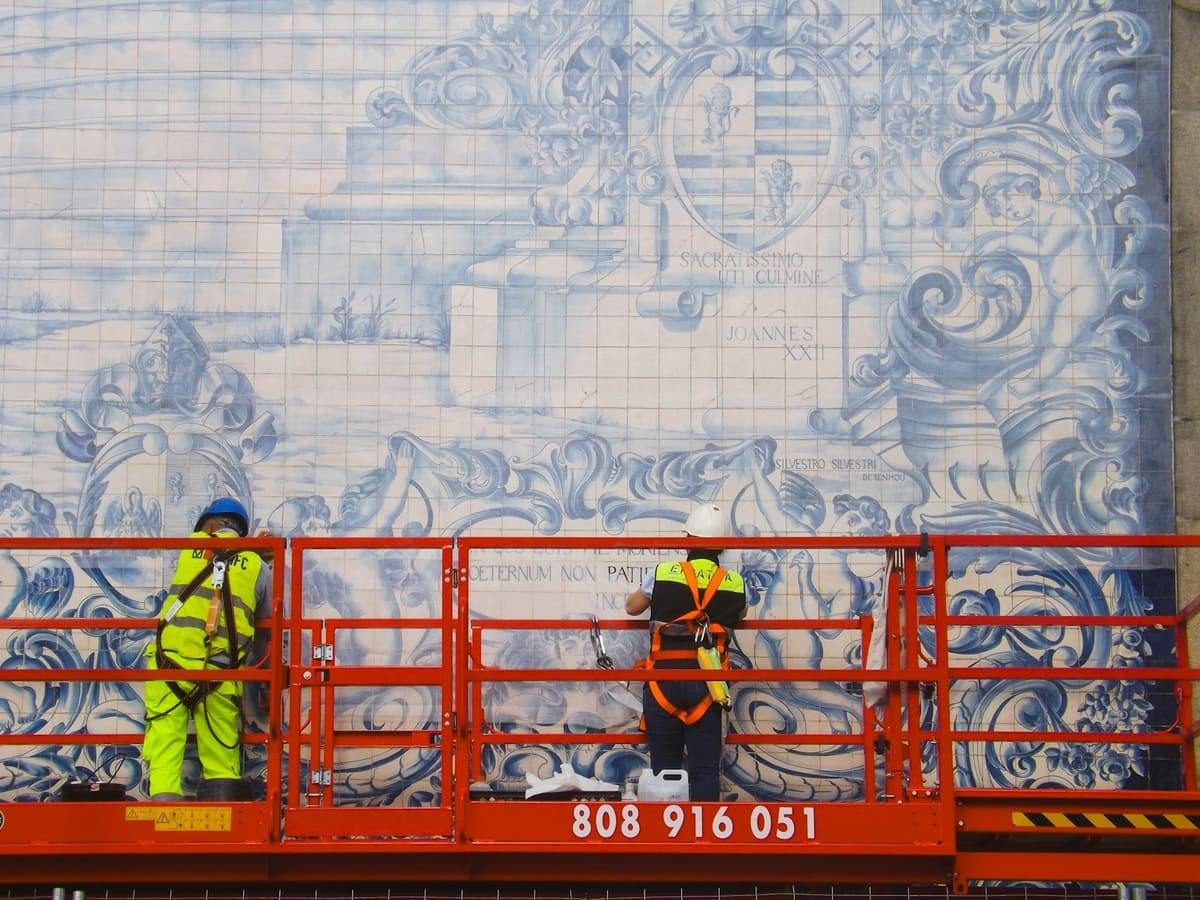
A well-painted facade lasts five, seven, even ten years without serious signs of degradation. When it starts to peel, stain, or lose colour before then, it is rarely the paint's fault alone. The error occurs during application, in the choice of materials, or at the moment the work was decided to begin.
Surface preparation determines everything that comes after
A facade that receives paint over dirt, accumulated dust, algae, mould, or degraded render will never hold the paint for long. Initial wall washing is essential to remove all dust1, but it is not enough. It is also necessary to repair cracks, remove loose paint, treat areas with active moisture, and in many cases, apply primer.
What fails in preparation
When the painter limits the work to sweeping or washing with a hose, adhesion becomes compromised. Mould stains, traces of grease, or layers of old paint already peeling create an unstable base. New paint adheres to this fragile layer, not to the wall itself.
Another common mistake: applying paint directly over new render or repair mortar without primer. The render absorbs water unevenly, the paint dries poorly, and after a short time, stains, peeling, or blisters begin to appear.
Surfaces that need specific treatment
| Surface type | Common problem | What needs to be done |
|---|---|---|
| New render | Excessive water absorption | Sealing primer before paint |
| Wall with cracks | Water infiltration | Repair with specific mortar and waterproof |
| Surface with mould or algae | Biological contamination | Wash with appropriate product and treat before painting |
| Old peeling paint | Lack of adhesion | Remove completely and prepare surface |
| Area with active moisture | Water entering through the wall | Resolve moisture cause before painting |
Climate at the time of application affects durability
Portuguese climate is becoming more extreme, with summers recording high average temperatures, more frequent heat waves, and more intense summer downpours2. Painting a facade in inadequate climatic conditions is a guarantee of problems in the short term.
Temperature and humidity
Exterior paint needs stable conditions to cure properly. Avoid working with paints when temperatures are below 10°C or above 40°C3. Temperatures too low make the paint thicken and difficult to apply; temperatures too high speed up surface drying but do not allow the paint to adhere properly at depth.
The same applies when relative air humidity is above 85%. On very humid days, the paint takes longer to dry, remains exposed longer to dust and contamination, and can create a weak film.
Rain in the first 48 hours
If it rains in the first 24 to 48 hours after application, the paint has not yet fully cured. Water can wash away pigment, create stains, or cause the film to peel. The ideal is that there is no forecast of rain in the three to five days following application4.
In regions such as Minho or inland areas with pronounced thermal swings, the window of stable weather can be short. The best time concentrates between May and September, avoiding the wettest winter months and ensuring the paint has consecutive days of dry weather to adhere and cure without interference.
Excessive direct sun also damages
Painting under direct sun, especially in the Algarve or on south-facing facades, makes the paint dry too quickly on the surface. Underneath, curing remains incomplete. After months, the film begins to crack and peel. The ideal is to work on days with moderate temperatures, without intense sun hitting directly on the surface during application.
Paint choice and number of coats
Not all paint labelled as "exterior" has the same resistance. Cheaper formulations may have less resin, less pigment, and fewer protective additives. The immediate result may even seem acceptable, but durability is compromised.
Paint suitable for local climate
In maritime zones, it is not enough to choose the right season, the right paint must be chosen. Formulations labelled as "for facades" or "exterior" already offer some protection, but in maritime zones it is worth confirming that they include reinforced anti-UV additives and resistance to salty environments.
In areas with greater sun exposure, such as Alentejo or the Algarve, UV resistance is critical. In humid areas, such as Minho or the Serra, resistance to fungi and algae counts more.
Insufficient coats
A single coat is never enough. Two coats are the minimum for a facade, even when the surface is in good condition. If there is a marked colour change (for example, from dark grey to white), three coats may be needed.
When the painter applies only one coat to save time or lower the budget, coverage is incomplete. Protection is weak and the paint degrades rapidly.
Signs that the facade was not well prepared or well painted
- Peeling in large flakes: the paint is peeling because it did not adhere to the surface. Problem with preparation or primer.
- Blisters or puffing: water or moisture under the paint. Can be infiltration, condensation, or painting over damp render.
- Dark or greenish stains: mould or algae. The surface was not treated before painting, or the paint does not have anti-fungal additives.
- Cracks in the paint that follow wall cracks: cracks were not repaired before painting. The paint follows the wall's movement and cracks.
- Uneven or faded colour in less than two years: poor quality paint, without UV resistance, or applied in conditions of excessive heat.
What to verify before accepting an exterior painting quote
Before accepting a proposal, confirm that the quote includes:
- Complete washing and cleaning of the surface.
- Repair of cracks and degraded areas.
- Application of primer where necessary.
- Two or three coats of paint suitable for the region's climate.
- Realistic timeline: a facade is not painted in one day.
Two facades with the same area may be in completely different states: one may have only accumulated dirt, the other may have cracks, active moisture, degraded render, or traces of mould. A serious quote reflects that difference.
On our platform5, all quotes start from an assessment of the actual surface condition. The professional sees the walls through photographs and videos or, if preferred, in a visit to the site. In both cases, the result is the same: a quote that reflects the necessary work, not just the area to paint.
The platform also records in writing everything that was agreed. The client, the professional, and the platform have access to the same document. There is no room for doubt or for extra work at the end.
Frequently Asked Questions
A good paint job should last 5 to 10 years on interior walls and 3 to 5 years on exteriors, depending on exposure to sun and rain. If the facade is peeling before that, something failed in the preparation, material, or application.
You can, but results vary. Autumn generally offers more stable and predictable climatic conditions. Autumn offers moderate temperatures and cooler days, which is ideal for this task. Summer can be too hot, winter too humid. Spring and autumn are the safest windows.
It is not normal, but it happens frequently. These areas usually accumulate moisture, have poorly sealed joints, or receive less attention in preparation. If peeling concentrates in these areas, the problem is almost always infiltration or lack of sealing.
Contact the professional who did the work. If the problem was an execution error (lack of preparation, application in unsuitable conditions, insufficient material), the work should be corrected. If the quote was closed on our platform, all agreed details are recorded and visible, which facilitates resolution.
Yes. The price difference between low-range paint and mid-range or high-range paint is usually offset by durability. Better paint resists sun, rain, salt, and fungi more, and requires less maintenance in the medium term. The extra cost in purchase saves money in the years to follow.
Ready to paint?
Get free quotes from verified local painters in minutes. No commitment.
Sources
External sources open in a new tab.
- Descubra o custo da pintura exterior por m² - Habitissimohabitissimo.pt
- Proteção de edifícios no verão : como preservar fachadas e telhados em Portugalscalpsas.pt
- O que deve ter em conta ao pintar a sua casa?hiperborea.pt
- Pintar fachada em Portugal: quando o clima ajuda ou complicapinturasportugal.pt
- Encontre um pintor em Lisboa que conhece a cidadepinturasportugal.pt